
You’re scrolling through someone’s Instagram caption and there it is, two bold letters right at the top: TW. Maybe you’ve seen it on Reddit threads, TikTok videos, or even in a group chat from a friend who’s about to share something heavy. And you thought, what does TW mean in text, exactly.
If you’ve been guessing it’s short for Twitter, you’re not alone. A lot of people do. But in most digital conversations today, TW carries a very specific, and actually quite important, meaning.
This article breaks down everything: the real definition, where it came from, how different platforms use it, and the unwritten rules around it that most people never explain.
What Does TW Mean in Text?
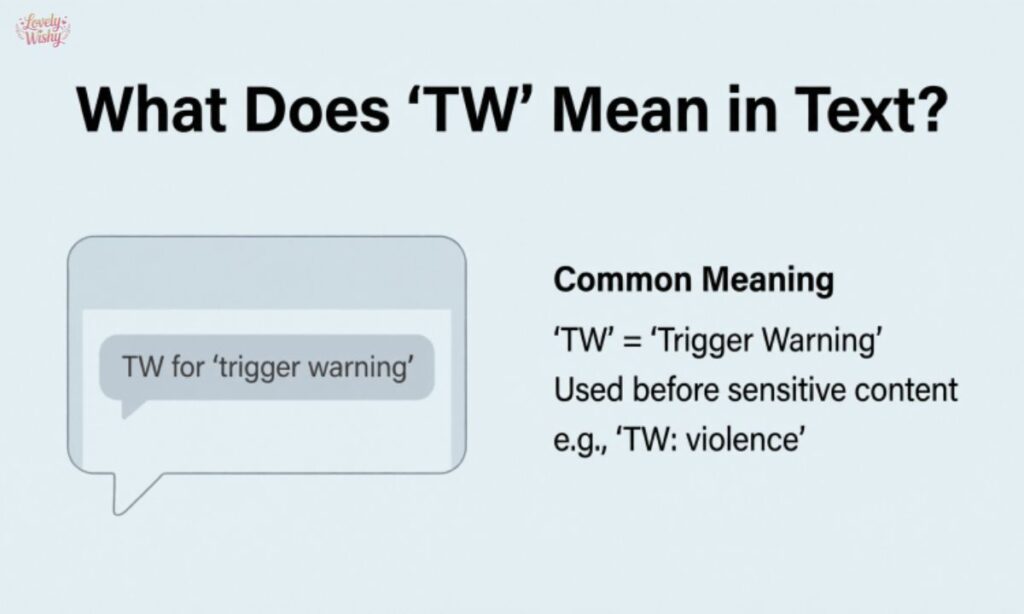
Simply put, TW stands for “Trigger Warning.
It’s a short heads-up placed before content that might be emotionally distressing, traumatic, or upsetting for the reader. Think of it like a yellow caution sign before a sharp curve on the highway. It doesn’t stop you from going forward, but it gives you a moment to prepare yourself or choose a different route.
You’ll typically see it written like:
- TW: eating disorders
- TW // self-harm
- TW ⚠️ — this post discusses grief
The idea is simple: the person sharing the content is saying, “Hey, what follows might be hard to read. I wanted to give you a chance to step back if you need to.
That’s it. Two letters. A small gesture but for some people, a genuinely significant one.
The History Behind TW (It’s Older Than You Think)
The concept of trigger warnings didn’t start on TikTok. It didn’t even start on Tumblr, though Tumblr definitely helped spread it.
The roots go back to early mental health and trauma communities online in the late 1990s and early 2000s. Forums for survivors of abuse, veterans dealing with PTSD, and people recovering from eating disorders would mark certain posts with warnings before graphic content. The logic was practical: someone who had experienced sexual assault, for example, shouldn’t be blindsided by detailed descriptions of assault without any notice.
Over time, the phrase trigger warning itself migrated into mainstream online spaces. By around 2010–2012, Tumblr had popularized TW as a hashtag people could filter out using browser extensions. If you didn’t want to see content about self-harm, you’d block the tag #TW and voilà, your feed became safer.
Then Twitter picked it up. Then Reddit. And eventually TikTok, where creators now routinely add TW in captions before emotional videos, mental health stories, or anything involving trauma.
What started as niche community etiquette became, in about a decade, a fairly standard part of how a lot of people communicate online.
How TW Is Used Across Different Platforms
Here’s where it gets interesting because TW doesn’t look exactly the same everywhere. Platform culture shapes how people apply it.
TikTok and Instagram Reels
On short-form video platforms, TW usually appears in the caption or as text overlay at the very beginning of a video. A creator talking about their experience with anxiety or body image issues might open with:
TW: body image, mental health discussion
It signals to viewers that what follows touches on emotionally heavy territory. TikTok’s algorithm has also, at various points, promoted this kind of labeling as part of its community wellbeing guidelines.
Reddit and Online Forums
Reddit’s usage is heavier on specificity. You’ll see TW in post titles, especially in mental health subreddits, trauma communities, or support threads. Moderators on many of these subs require it as part of posting rules.
A typical Reddit title might read: TW: abuse needs to talk through something that happened to me.
The format is usually TW: [specific topic] so readers know exactly what they’re opting into.
Text Messages and Direct Messages
In personal conversations, TW is more casual but still meaningful. Someone might text a close friend:
Hey, TW I need to vent about something. It involves some stuff about my mom’s health.
It’s a way of asking for consent before diving into something heavy. Sort of like saying “Are you in a good headspace for this?” but quicker and less awkward to type.
Twitter / X
On Twitter, TW shows up in threads dealing with sensitive news, personal stories, or social commentary on difficult topics. The format is often TW // followed by the subject. Some users also use it sarcastically, more on that in a moment.
TW vs. CW — What’s the Difference?
People sometimes mix these up, but they’re not quite the same thing.
- TW (Trigger Warning) specifically flags content that might cause a trauma response or emotional distress. It’s more intense in scope, aimed at people who may have personal history with the topic.
- CW (Content Warning) a broader alert. Used for content that might be uncomfortable or sensitive for general audiences, but not necessarily trauma-inducing. Violence in a movie review, strong language in a blog post, or political content that might upset some readers.
Think of CW as the wider net and TW as the more specific, more urgent signal. If you’re writing about the general themes of addiction in a film, a CW might be enough. If you’re sharing a personal account of your own recovery in detail, a TW is more appropriate.
Other Meanings of TW (Context Matters — A Lot)
Here’s where things get a bit murkier. TW isn’t a one-meaning acronym in all contexts. Outside of social media and casual texting, it can mean:
| Context | TW Stands For |
| Work emails / scheduling | This Week (“I’ll send the report TW”) |
| Physics / energy | Terawatt (a unit of power) |
| Aviation | Tailwind |
| LGBT+ community | Trans Woman |
| Jewelry industry | Total Weight (referring to diamond carat weight) |
| Older internet slang | Tweet (less common now) |
So if your manager sends a message saying Let’s finalize this TW, they almost certainly mean this week, not trigger warning. Always read the room, or in this case, read the email thread.
The Right Way to Use TW (and Common Mistakes)
Using TW is more of a social skill than a technical one. There are no official rules, but there are definitely habits that make it more useful, and habits that water it down.
Do These Things
- Be specific. TW alone isn’t as helpful as TW: suicide mention or TW: graphic violence. The more specific, the more useful.
- Put it first. The warning only works if it comes before the triggering content. Putting a TW at the end of a post defeats the purpose entirely.
- Use it sincerely. When you add a TW because you genuinely care about your audience’s wellbeing, it lands differently than when it’s tacked on as an afterthought.
Avoid These Habits
- Over-applying it to minor discomforts. Tagging every mildly awkward post with TW can desensitize readers and make the signal lose meaning. Not every uncomfortable topic needs the same warning as content about self-harm.
- Using it sarcastically to mock people. This happens, some users add TW: opinions or TW: facts to mock those they think are too sensitive. It’s mean-spirited and erodes trust in the label.
- Forgetting it entirely in high-stakes content. If you’re posting detailed first-person accounts of trauma, please use TW. Skipping it isn’t brave; it’s just inconsiderate.
Pros and Cons of Trigger Warning Culture Online
Like most things on the internet, TW culture has genuine benefits and real criticisms. Here’s an honest look at both sides.
The Case For TW
- It gives readers agency and choice before engaging with hard content
- It protects people with PTSD, anxiety disorders, or trauma histories from unexpected distress
- It signals that the person sharing the content is aware of their audience
- It normalizes talking about difficult topics while still being thoughtful about how
The Criticisms
- Overuse can create warning fatigue readers stop taking them seriously
- It can sometimes feel like it’s shielding people from reality rather than helping them prepare for it
- The line between what needs a TW and what doesn’t is genuinely fuzzy
- Some argue it can inadvertently frame certain topics as always harmful to discuss
The truth? Both sides have valid points. Used thoughtfully, TW is a tool for empathy. Used carelessly or sarcastically, it loses its value.
Practical Tips for Using TW in Your Posts and Texts
Whether you’re a content creator or just someone with an emotionally honest group chat, here’s how to do it well:
- Ask yourself: “Could this genuinely distress someone who has personal experience with this topic. If yes, add a TW.
- Format it clearly. Use uppercase letters, a colon, and name the topic: TW: domestic abuse.
- Give people space to opt out. If possible, put the sensitive content behind a line break or a read more so the warning is the first thing they see.
- Don’t pair TW with judgment. No TW for the sensitive people out there. Just the warning, clean and simple.
- Respond graciously if someone asks you to add one. They’re not being dramatic, they’re advocating for their own wellbeing.
Frequently Asked Questions
Is TW slang
Not exactly. It’s an abbreviation, and while it originated in online spaces, it’s now used seriously across social media, professional content, and educational settings. It’s not casual slang the way “lol” is.
Does TW mean the same thing on all platforms
Mostly yes, in the sense that “Trigger Warning is the dominant meaning in personal and social media contexts. But in professional emails or technical writing, it might mean this week,terawatt, or something else entirely. Context is your guide.
What should I do when I see a TW
Pause and honestly assess whether you’re in a good headspace to engage with that content. If you are, go ahead. If not, it’s completely fine to scroll past. The whole point of TW is to give you that choice.
Do I have to use TW? Is it mandatory
No. There’s no platform law requiring it (though some communities and subreddits have their own rules). It’s a social courtesy, not a legal obligation. But like most courtesies, it says something about who you are when you choose to use it.
What’s the difference between TW and NSFW
NSFW (Not Safe For Work) is typically used for sexually explicit or graphic content that would be inappropriate in a professional setting. TW is about emotional or psychological sensitivity. They sometimes overlap, graphic violence might warrant both, but they’re not the same label.
Final Thoughts
There’s something quietly meaningful about the fact that a two-letter abbreviation has become shorthand for I see you, and I don’t want to accidentally hurt you.
TW started in small corners of the internet where people were trying to look out for each other. It’s grown into something wider now, a signal that digital communication doesn’t have to be a free-for-all where anything goes without warning. You can talk about hard things. You can share dark content, personal pain, heavy news. TW doesn’t stop any of that. It just gives people a moment to brace themselves, or opt out entirely.
So the next time you’re about to post something heavy, a personal story, a difficult article, a video with upsetting content, consider those two little letters. They take two seconds to type. For someone on the other end, they might matter a lot more than that.

LovelyWishy is a warm space filled with meaningful wishes, heartfelt messages, and thoughtful responses. We create simple, beautiful words that help you express emotions, celebrate moments, and connect with the people you love in a special and memorable way.