

You’re scrolling through your DMs and someone fires off a quick TTM and now you’re staring at your screen wondering what they actually want. Don’t worry. You’re definitely not alone. Texting abbreviations have become their own language at this point, and TTM is one of those short little codes that shows up everywhere from Snapchat streaks to Instagram stories to late-night text conversations.
So what does TTM actually mean? And more importantly how do you respond to it without looking clueless? That’s exactly what this guide is for. We’re going to break it all down, look at every context it pops up in, and give you real examples you can actually use.
What Does TTM Mean in Text?
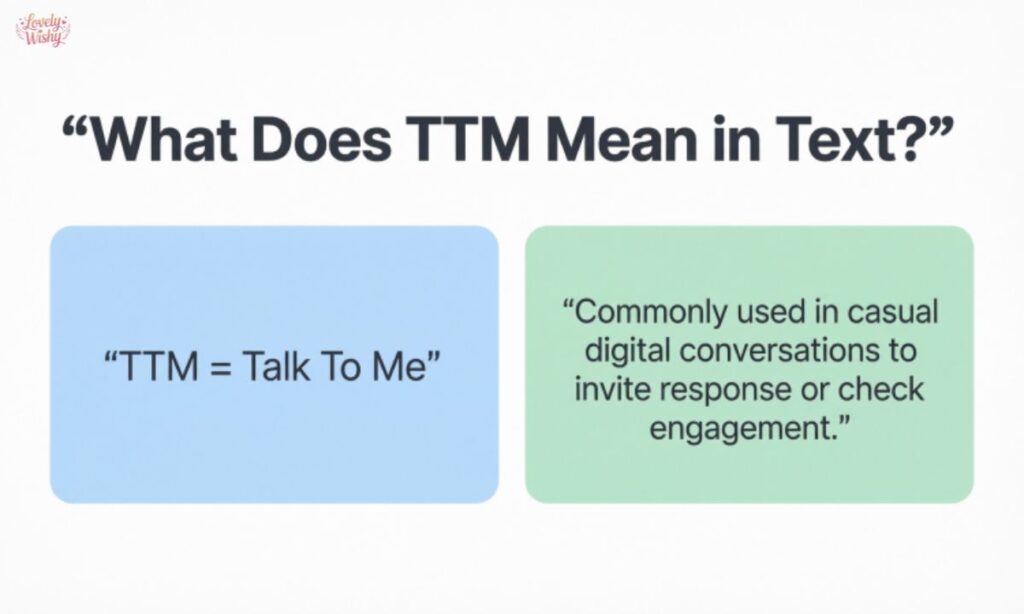
The most common meaning of TTM in text messages and social media is “Talk To Me.” Simple as that. It’s an open invitation, a casual nudge that says, hey, I want to hear from you.
When someone sends you TTM, they’re typically:
- Asking you to reach out and start chatting
- Checking in because they haven’t heard from you in a while
- Expressing that they’re available and in the mood to talk
- Sometimes flirting, depending on the tone and context
The abbreviation is commonly used in text messaging and online communication when someone wants to have a conversation or when they want the other person to reach out to them. It’s warm and low-pressure, less demanding than CALL ME NOW and more personal than just sending a hey.
The Origin Story: Where Did TTM Come From?
Texting abbreviations didn’t appear overnight. They evolved slowly, born out of necessity, old-school SMS had character limits, and typing on a numeric keypad was basically a full workout. So people got creative.
TTM gained traction with the rise of social platforms like MySpace, Facebook, and Twitter, where users began shortening phrases to save time and characters. Over time, it became an easy and expressive way to ask someone to message back, especially in a friendly or flirty tone.
Today, it remains widely used on Snapchat, TikTok, and Instagram, especially among younger audiences who prefer quick, expressive abbreviations.
Think about how language has always adapted to its medium. Letters became telegrams, telegrams became phone calls, calls became texts, and texting developed its own shorthand vocabulary. TTM is just one natural piece of that evolution.
TTM Across Different Platforms: It’s Not One-Size-Fits-All
Here’s the thing, TTM doesn’t feel exactly the same everywhere. The platform changes the vibe.
TTM on Snapchat
On Snapchat, TTM is super common and usually very casual. People will drop it in a snap or a chat when they want to reconnect. You’ll often see it after a long streak silence or when someone just wants company. Something like: Haven’t snapped in forever, TTM.
TTM on Instagram
Instagram gives TTM a slightly more public energy. Creators use it in stories and comment sections to boost engagement. In posts and comments, TTM can start conversations; in direct messages, a reply with TTM keeps the chat going and creates a more personal connection with followers.
TTM in Regular Text Messages
In a standard SMS or iMessage situation, TTM is more intimate. It usually signals emotional availability I’m here, reach out. Someone dealing with something hard might text a friend: “Bro I’m having the worst week. TTM. That hits different than a simple hey.
TTM on Dating Apps
This one’s interesting. On Tinder, Hinge, or Bumble, a TTM often carries a lightly flirty undercurrent. Profiles may include “bored, TTM” to invite messages. On dating apps, it often carries a lightly flirty tone, suggesting openness to conversation.
All the Different Things TTM Can Mean
Most of the time, TTM = Talk To Me. But language isn’t always that neat.
While “Talk To Me” is the most common interpretation of TTM in casual conversations, the acronym can have several meanings depending on the context. Here’s a quick breakdown:
| Context | TTM Meaning |
| Casual texting / social media | Talk To Me |
| Finance / business reports | Trailing Twelve Months |
| Product development / tech | Time To Market |
| Rare slang usage | To The Max |
| Parental monitoring apps | Texting Time Management |
So if you’re in a work Slack and your manager says our TTM revenue was down this quarter, they’re definitely not asking you to chat. Context is everything.
Real-World TTM Examples You’ll Actually Recognize
Let’s ground this with some actual scenarios. Because nothing explains slang better than seeing it live in the wild.
Example 1 — The Check-In:
“Hey, you’ve been quiet all week. TTM, you okay?”
This is caring. Someone’s noticed your absence and wants to know you’re alright.
Example 2 — The Flirty Ping:
Saw your story… you looked great btw. TTM 😉
Yep. Classic. They want the conversation started and they’re making it pretty obvious.
Example 3 — The Update Request:
Did you get the job?! TTM when you find out.
Here it’s excitement mixed with impatience. A friend invested in your situation.
Example 4 — The Support Offer:
Heard things have been rough lately. No pressure, but TTM if you need someone.
One of the most genuine ways TTM gets used. It’s an open door without any obligation attached.
Examples like Hey, I’ve been feeling down lately TTM, I could use a friend right now or I had a great time hanging out with you last night, TTM, we should do it again soon!” illustrate how versatile the term really is.
TTM vs. Similar Texting Slang: What’s the Difference?
People often confuse TTM with a few similar abbreviations. Here’s how they’re different:
- TTM vs. HMU HMU (“Hit Me Up”) means reach out to me at some point. TTM is more immediate it’s talk to me now, or soon.
- TTM vs. TTYL TTYL (“Talk To You Later”) wraps up a conversation. TTM opens one. Opposite energies.
- TTM vs. DM Me DM Me is platform-specific (usually Instagram or Twitter). TTM works anywhere, any medium.
- TTM vs. WYD WYD asks what you’re doing. TTM just wants the conversation started, no agenda attached.
Each term has a similar goal but a different vibe. Think of them as siblings, not twins.
Pros and Cons of Using TTM in Your Conversations
Like any piece of digital slang, TTM has its sweet spots and its awkward moments.
The Upsides
- It’s warm and low-pressure. Unlike why aren’t you texting me back, TTM invites without demanding.
- Short and punchy. In a world of endless notifications, a two-second message can be more effective than a paragraph.
- Emotionally versatile. It works when you’re being flirty, supportive, curious, or just bored.
- Great for engagement especially for creators who want their audience to interact.
The Downsides
- Without context, it’s hard to determine the tone behind TTM. Is it an urgent request? A casual invitation? Or perhaps an annoyed prod for someone to clarify themselves?
- It’s not for everyone. Older contacts or people outside texting culture might find it confusing or even blunt.
- While brevity is one of texting’s defining features, sometimes being too concise can come off as impatient or even rude.
- Different fields = different meanings. Drop it in the wrong professional context and things get awkward fast.
Practical Tips for Using TTM the Right Way
Learning the definition is step one. Using it well is a whole other skill. Here’s how to get it right:
1. Read the room first. Are you texting a close friend or messaging a new acquaintance? TTM works better with people you already know.
2. Add a little context when needed. “TTM about your trip!” lands much better than just a standalone “TTM” out of nowhere.
3. Never use it in formal settings. Skip using TTM in business emails, formal communications, or with people unfamiliar with texting slang. “Let’s connect” or “I’d love to discuss this” serve you much better professionally.
4. Don’t spam it. TTM is powerful but can become less special if used too much. Use it wisely to keep it effective.
5. Pair it with an emoji for warmth. A bare TTM can feel abrupt. A “TTM 😊” or “TTM 💬” adds a whole different emotional texture.
6. Respect the non-response. If someone doesn’t reply to your TTM, that’s an answer too. Don’t follow up with three more.
How to Respond When Someone Sends You TTM
This trips people up more than you’d think. What do you actually say back?
It really depends on how you feel. There’s no script here, but here are some natural responses for different situations:
- If you want to talk: Sure, What’s on your mind or Hey! What’s up
- If you’re busy right now: Can’t right now but hit me up tonight
- If you’re not sure what they mean: “TTM about what? 😂
- If you’re not really feeling it: A polite short reply usually does the job. You don’t owe a lengthy explanation.
There’s no fixed rule, match your response to how you feel. The beauty of casual texting slang is that it doesn’t require a formal protocol.
Frequently Asked Questions
Is TTM always about talking
Mostly, yes, in casual conversation. But in finance, it commonly refers to Trailing Twelve Months, and in product circles it means Time To Market.
Can TTM be flirty
Absolutely. Context and tone decide everything. A TTM 😉 on a dating app carries a very different energy than a supportive “TTM if you need me.
Is TTM rude
Not inherently. In online slang, TTM is usually seen as casual and playful rather than rude. But tone and context can shift that perception, it can read as pushy if it’s sent repeatedly or in the wrong situation.
Should I use TTM at work
No. Keep it for personal texting and casual social media. Professional settings deserve professional language.
What’s the difference between TTM and TTMN
TTMN means Talk To Me Now a more urgent version. TTM is softer and more general.
Is TTM popular globally
TTM is most common in English-speaking regions, especially in the US, UK, Canada, and Australia.
Conclusion: TTM Is Simpler Than It Looks
At the end of the day, TTM is just three letters with a lot of heart behind them. Whether it’s a friend checking in, someone flirting from across the internet, or a creator inviting their followers to engage TTM is an open door.
Now that you know what it means, how it shifts across platforms, and when it’s appropriate to use it, you’ve got everything you need to navigate it confidently. The next time someone hits you with a casual “TTM,” you’ll know exactly what they mean and exactly what to say back.
Digital slang moves fast, but the human need behind it? That stays the same. People just want to connect. TTM, in all its casual three-letter glory, is proof of that.

LovelyWishy is a warm space filled with meaningful wishes, heartfelt messages, and thoughtful responses. We create simple, beautiful words that help you express emotions, celebrate moments, and connect with the people you love in a special and memorable way.