
You’re scrolling through Instagram, maybe late at night when your brain’s already doing too much. A friend’s post pops up, and right at the top, before anything else, you see: TW.You pause. You’ve seen it before probably dozens of times but maybe you’ve never fully stopped to ask: what does TW mean in text, exactly And why do people use it.
It’s one of those abbreviations that looks small but carries a lot of weight. And once you understand it, you’ll start seeing it everywhere in DMs, Twitter threads, TikTok captions, Reddit posts, even academic syllabi. So let’s break it down properly, because this isn’t just a two-letter abbreviation. It’s a whole conversation about empathy, digital communication, and how we look out for each other online.
What Does TW Mean in Text?
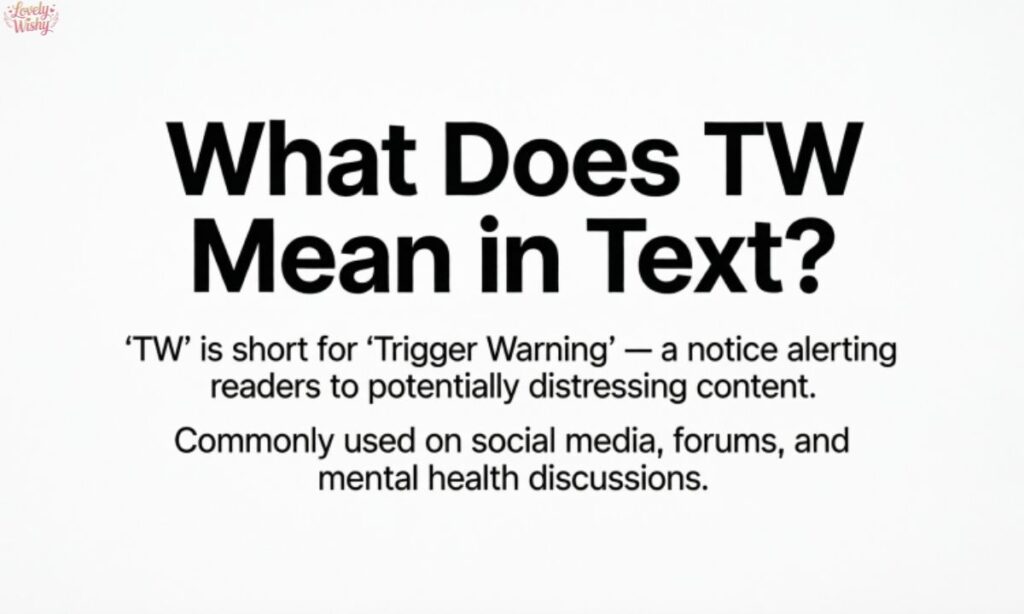
The most common meaning of TW in text is Trigger Warning.That’s it, in the simplest terms. It’s a short heads-up a way of saying, Hey, what comes next might be emotionally heavy. Proceed if you’re in the right headspace.
The term “trigger warning” originated as a way to protect individuals with PTSD or other mental health concerns from encountering content that might cause a strong emotional response or flashback. Over time, it got shortened to TW, and people started dropping it into messages and posts the way you’d clear your throat before delivering difficult news.
The TW meaning in text as “Trigger Warning” first gained traction in online mental health communities and forums during the early 2000s. But it didn’t stay niche for long.
The Most Common Uses of TW
Here’s what TW typically precedes in everyday digital communication:
- Mental health discussions (depression, anxiety, self-harm)
- Accounts of trauma, abuse, or assault
- Graphic violence or disturbing imagery
- Eating disorder content
- Grief, death, or loss
- Racial or social injustice topics
- Spoilers (yes, some people use TW for that too, different discussion)
The key thing is that TW always appears at the beginning of a message, post, or caption. That placement is intentional. It gives the reader a choice before they’ve already absorbed the content.
The Origin Story — Where Did TW Come From?
Here’s a little context most people don’t know.
Trigger warnings didn’t start on social media. They actually trace back to feminist forums and survivor support spaces online in the late 1990s and early 2000s. People sharing experiences of sexual violence and trauma began tagging posts so that other survivors could make an informed decision about whether they were emotionally ready to read something.
In the early 2010s, communities on Tumblr and Reddit began adding trigger warnings to protect survivors of trauma from unexpected emotional triggers. Over time, TW evolved into quick shorthand — now used across TikTok, YouTube, Instagram, and text messages.
Between 2010 and 2015, Tumblr and Twitter popularized TW, making the trigger warning meaning standard practice in social media etiquette.
By the time TikTok arrived and Gen Z became the dominant force in internet culture, TW was already baked into the vocabulary. Younger users embraced it not just for severe trauma but for any content that might catch someone off guard emotionally.
TW Meaning Across Different Platforms
This is where it gets interesting, because TW doesn’t behave exactly the same everywhere. Context is everything.
TW on TikTok
On TikTok, creators often include #TW in video captions to indicate that the video may contain sensitive themes. You’ll sometimes see it as text on screen at the start of a video, giving viewers about two seconds to decide if they want to keep watching.
What’s notable on TikTok is that the audience is young, scroll-happy, and often encountering content from creators they don’t know personally. A TW there feels less like a friend’s heads-up and more like a content label, functional, quick, and increasingly expected.
TW on Instagram and WhatsApp
On chat apps like WhatsApp and Instagram, TW almost always means Trigger Warning, especially when users post about mental health or emotional topics.
On Instagram in particular, you’ll see it in story captions, post descriptions, and sometimes mid-thread in comments sections. In WhatsApp group chats, it tends to feel more personal — like someone pre-warning their friends before diving into something heavy during a group conversation.
TW on Twitter/X and Reddit
These two platforms have a longer history with TW than most. Reddit’s mental health subreddits practically codified the practice, and many communities require trigger warnings in post flairs or titles. Twitter (now X) users often write “TW //” or “TW:” followed by the specific topic, placed before a long thread about something difficult.
TW in Other Contexts — It’s Not Always Trigger Warning
Okay, here’s where you need to pay attention to context, because TW doesn’t always mean Trigger Warning. Depending on who’s writing it and where, it could mean something completely different.
Beyond texting and social media, the TW meaning in text pops up in professional and specialized contexts. In business and corporate settings, TW often means “This Week” in meeting agendas, project timelines, and status updates.
Other meanings include:
- Trigger Word — similar concept, used in some psychological and academic writing
- Trans Woman — used as an identity abbreviation within LGBTQ+ communities
- Total Weight — in the jewelry industry, referring to the total carat weight of diamonds
- Terawatt — a unit of power in physics and energy sectors
- Tailwind — in aviation, describing wind direction relative to aircraft travel
- Teamwork — occasionally in workplace Slack channels or project boards
In aviation, TW can mean Tailwind, describing wind that blows in the same direction as an aircraft’s travel, crucial in flight operations.
The safest rule? If you’re on social media or texting about something emotionally charged, TW = Trigger Warning. If you’re in a business email or technical document, pump the brakes and read the context.
TW vs. CW — What’s the Difference?
You might have seen both TW and CW floating around, especially on platforms like Tumblr and Mastodon. They’re related but not the same.
TW stands for emotional or trauma triggers, while CW stands for general sensitive content.
Think of it this way: a TW is more urgent and trauma-specific. A CW (Content Warning) is broader, it might flag disturbing but not necessarily triggering material. A graphic description of war might get a TW. A post about a pet’s death might get a CW. The distinction matters in communities that use both intentionally.
Some platforms, like Mastodon, have a built-in “Content Warning” feature that essentially functions the same way, hiding content behind a click until the reader chooses to reveal it.
Real-World Examples of TW in Text
Let’s see how TW actually shows up in everyday conversation. These are realistic examples of how people use it:
In a group chat:
TW: I need to vent about something really heavy that happened at work. Involves harassment, so skip if you’re not in the headspace for it right now.
On Twitter/X:
TW // eating disorder mention, a thread about my recovery and what’s helped me over the past two years.
In an Instagram caption:
TW ⚠️ depression, I don’t usually post about this but I wanted to be honest today. Things have been hard.
In a text to a friend:
Hey, TW before I tell you what happened, it’s kind of upsetting.
In an email from a professor:
TW: The reading for Thursday covers graphic accounts of historical violence.
Notice how in every case, TW appears first, before any content, and is usually followed by a specific topic. The specificity matters, a vague “TW” alone doesn’t give the reader enough information to decide whether to proceed.
Pros and Cons of Using TW in Online Communication
Like most things on the internet, TW isn’t without debate. Here’s an honest look at both sides.
Why TW Is Genuinely Useful
It gives people a choice. Not everyone is in a stable emotional state when they open their phone. A trigger warning is a small but meaningful act of respect, it says, “I thought about you before I posted this.
It normalizes mental health conversations. The very act of acknowledging that some content is emotionally heavy helps destigmatize mental health topics. You’re not hiding the subject; you’re just creating a moment of consent before someone engages.
It’s become expected in many communities. In mental health forums, survivor spaces, and fan communities, failing to include a TW when appropriate is considered a breach of community etiquette, similar to posting a spoiler without warning.
It’s quick and low-effort. Two letters. That’s all it takes to potentially protect someone’s day.
Where TW Falls Short
Overuse dulls the signal. When TW appears before every mildly uncomfortable topic, a post about a stressful commute, a mildly spicy opinion, even food photos, it starts to lose meaning. If everything is a trigger warning, nothing is.
Vague warnings don’t help. Just writing “TW” without specifying the topic is almost useless. “TW: violence” gives someone a choice. “TW” alone gives them nothing.
Not everyone knows what it means. In Western countries, TW is widely known and frequently applied in social media, blogs, and educational contexts. In other regions, the abbreviation may be less familiar, requiring either explanation or use of the full phrase “Trigger Warning” to ensure understanding.
Some people misuse it sarcastically. Some online trolls use TW to mock people they consider easily offended, the trigger warning is actually meant to trigger them. This is a real pattern, and it’s worth knowing it exists.
How to Use TW Correctly — Practical Tips
If you want to use TW thoughtfully and effectively, here’s what actually works:
- Always be specific. Write “TW: self-harm” or “TW: sexual assault,” not just “TW.” The specificity is the point.
- Place it at the very start. Before any content, before any context, before even your opening sentence. The warning has to come first.
- Use it for content with genuine emotional weight. Not for minor inconveniences or mildly unpopular opinions.
- Don’t bury it in a wall of text. Make it visually distinct — a new line, a colon, a dash. Something that makes it jump out.
- Consider your audience. In a public post to thousands, a TW is almost always appropriate for heavy content. In a one-on-one conversation with someone you know well, you can judge based on context.
- Respond to other people’s TW with respect. If someone labels content with TW and you engage with it, acknowledge the warning. Don’t minimize it with “it’s not a big deal” you don’t know their history.
The Broader Meaning: What TW Says About How We Communicate Online
There’s something worth pausing on here. The fact that TW exists, that it spread organically from small trauma-support communities to mainstream internet culture, that says something.
“TW” may look small, but it reflects something much bigger, a shift toward more thoughtful, human-centered communication. It’s not just about warning people. It’s about respecting their experiences, emotions, and boundaries. In a world where content moves fast and reactions are instant, something as simple as “TW” creates a pause, a moment of awareness.
We’ve built a communication ecosystem that moves faster than our emotions can process. TW is a friction point, a small, deliberate pause. And in a media environment optimized for engagement at all costs, building in empathy signals like TW feels genuinely countercultural.
Frequently Asked Questions
What does TW mean in a text message
Most commonly, TW means Trigger Warning, a heads-up that the following content may be emotionally difficult or distressing.
Is TW slang or a formal term
TW stands for “Trigger Warning.” It’s an abbreviation, not exactly slang, but it’s commonly used in internet culture. In academic and professional settings, the full phrase “Trigger Warning” is often preferred.
What’s the difference between TW and CW
TW is specifically for content that may trigger trauma responses. CW (Content Warning) is broader and used for generally sensitive or upsetting material that isn’t necessarily traumatic.
Can TW mean something other than Trigger Warning
Yes, in business contexts it can mean “This Week,” in aviation it can mean “Tailwind,” and in LGBTQ+ communities it sometimes stands for “Trans Woman.” Always read the context.
Should I use TW in text messages to friends
Yes, if you’re about to share something heavy or emotionally charged. It’s a small gesture that shows you’re thinking about how the other person might receive the content.
Is it rude to skip a TW
In sensitive communities, yes, it can be considered thoughtless or inconsiderate. It’s not about legal obligation; it’s about social responsibility.
Why do some people mock trigger warnings
Unfortunately, some people use TW sarcastically to ridicule others they perceive as overly sensitive. This misuse is separate from the genuine and valuable original purpose of the term.
Does TW work on all platforms
It’s most recognized on Twitter/X, Instagram, TikTok, Reddit, and Tumblr. Some platforms like Mastodon have built-in content warning features. In emails and professional communication, spelling out “Trigger Warning” is usually clearer.
Conclusion: Two Letters, A Lot of Meaning
Here’s the bottom line. TW, in most online and texting contexts, means Trigger Warning. It’s a two-letter abbreviation that became a cultural norm because it addresses a real human need: the need to not be blindsided by content that could genuinely hurt you.It didn’t come from a policy memo or a social media platform’s terms of service. It grew from communities of people who decided, collectively, that looking out for each other online was worth the extra two keystrokes. That’s actually kind of remarkable.
Whether you’re using it, seeing it, or explaining it to someone who just asked “what does TW mean in text. the answer is always the same at its core: it means someone is trying to be considerate. And in a fast, loud, often overwhelming digital world, that still counts for something.Use it when it matters. Be specific. Put it first. And when someone else uses it, respect it.

LovelyWishy is a warm space filled with meaningful wishes, heartfelt messages, and thoughtful responses. We create simple, beautiful words that help you express emotions, celebrate moments, and connect with the people you love in a special and memorable way.