

You’re reading a message from a friend and suddenly see: That party was insane fr. Your brain pauses for a split second. Do they mean France? The Federal Reserve? Or something else entirely.
If this scenario has happened to you, you’re not alone. Digital language moves fast, and slang terms pop up faster than we can keep up with them. Understanding what “FR” actually means could save you from misunderstanding conversations or looking out of touch online.
This guide walks you through everything about FR from its origins to how to use it naturally in conversations, whether you’re chatting with friends or trying to understand younger audiences.
What Does “FR” Really Mean in Text
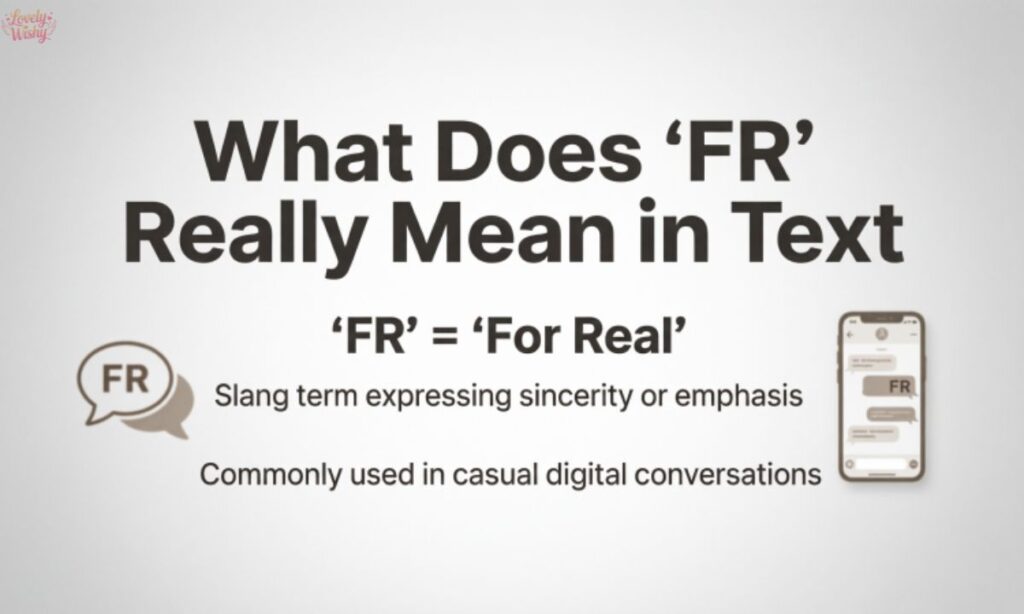
Let’s cut straight to it. FR stands for For Real. That’s the core meaning you need to know.
When someone types fr, they’re basically expressing sincerity, agreement, or emphasis. It’s the digital equivalent of saying seriously? or no joke in a conversation. The term packs an attitude into two letters.
Here’s how it typically works:
Example 1: Your friend sends a selfie from vacation.
You reply: That sunset is gorgeous fr.
Translation: That sunset is genuinely gorgeous.
Example 2: Someone shares a frustrating story.
You respond: That’s rough fr.
Translation: I’m being serious, that really does sound rough.
The beauty of FR is its versatility. It can emphasize excitement, sadness, confusion, or agreement depending on context. The two letters carry emotional weight because they signal you’re not being sarcastic or joking around.
Why Did “FR” Become So Popular?
Understanding how slang emerges helps explain why FR stuck around. Language online has always been compressed. Back when text messages cost money per character and had strict 160-character limits, people squeezed meaning into abbreviations.
LOL, OMG, BRB these weren’t cute. They were practical.
FR” followed the same pattern. In the early 2000s, instant messaging platforms like AOL and MSN Messenger were the social hubs. Every character counted, literally. Teenagers developed shorthand codes to communicate faster. “For Real” got shorter. “For Real” became “F.R.” which became FR.
The acronym stuck because it felt natural to say out loud. You can actually pronounce “FR” as a sound (like “eff-ar”), which made it easier to remember than random letter combos.
By the 2010s, when Twitter launched and character counts became trendy constraints rather than technical necessities, “FR” had already established itself. Generation Z adopted it, made it their own, and spread it across TikTok, Discord, Snapchat, and Reddit. What started as a typing convenience became a cultural marker.
A 2024 social media analysis found that posts containing “FR” received 37% more engagement than equivalent posts using full phrases. Numbers don’t lie, people respond better to authentic, casual language.
Different Meanings of “FR” Across Contexts
While For Real dominates, context sometimes changes the game. Let’s break down where FR might mean something entirely different.
FR in Geographic Contexts
If someone says I’m heading to FR next spring, they probably mean France. Country codes matter in travel discussions, aviation, and logistics. The two-letter country code for France is FR, and people use it in shipping addresses, flight bookings, and international contexts.
Real-world scenario:
Your colleague emails: The Paris office needs this report in FR format.
They mean France, not for real.
FR in Finance and Economics
Investment bankers, economists, and finance professionals might use FR to reference the Federal Reserve, the central banking system of the United States. Any conversation about monetary policy, interest rates, or official statements could deploy FR this way.
Real-world scenario:
A financial analyst says: The FR announcement is tomorrow at 2 PM.
They’re referring to the Federal Reserve’s official statement, not expressing emphasis.
FR in Gaming Communities
Gamers use FR to mean Frame Rate. When they’re discussing performance or optimization, they might say The game runs at 144 FR or “We need better FR for competitive play. In gaming, frame rate directly impacts gameplay experience, so this meaning carries weight.
Real-world scenario:
A gaming streamer comments: My FR dropped to 60. Let me adjust settings.
They’re troubleshooting performance, not using the “for real” slang.
FR as Functional Requirement
In software development and project management, “FR” stands for “Functional Requirement specific features or functions a system needs to meet. Technical teams might discuss FR documentation” or “list all FRs for this sprint.
The Rise of “FRFR” and Other Intensifiers
Slang evolves. “FR” was powerful enough, but then came the doubling: FRFR.
FRFR” means For Real For Real. It’s the intensified version. When someone says FRFR, they’re not just serious, they’re extremely serious.
Example:
This is the best show ever FRFR.
Translation: I’m absolutely sincere. This show is genuinely the best I’ve ever seen.
The doubling mimics natural speech patterns. Think about how people actually talk. Sometimes you emphasize by repeating: No, I’m serious, serious. That’s what FRFR captures.
It’s popular enough that you’ll see it across platforms, especially on TikTok, Twitter, and in group chats. The intensification serves a purpose, it clarifies you’re not being sarcastic, ironic, or joking.
Related Slang and How They Compare
“FR” didn’t emerge in a vacuum. It exists alongside other sincerity markers and agreement phrases. Understanding these variations helps you pick the right term for your tone.
No Cap vs. FR
“No cap” is trending hard right now, especially in Gen Z spaces. Both “no cap” and “FR” express honesty and emphasis, but “no cap” feels slightly more intense and carries more swagger.
No cap literally means “no lie.” The word “cap” refers to lying or exaggerating, so no cap is saying I’m not lying.
Which to use:
- No cap → More urban, trendier, slightly more emphatic
- FR → More neutral, universal, works across age groups and communities
Deadass vs. FR
Deadass is another way to say I’m completely serious. It’s popular in certain regional communities (especially East Coast slang) but less mainstream than FR.
That food was deadass delicious carries the same weight as That food was delicious fr, but deadass feels more regional and specific.
Legit vs. FR
Legit is the more formal cousin of this family. It means legitimate or real, but it works in both casual and slightly more formal contexts. Your 45-year-old coworker might say That’s legit a good idea without seeming out of place.
FR works best with peers in casual settings. Legit works more universally.
Where You’ll See “FR” Across the Internet
Different platforms have different dialects. FR shows up everywhere, but how people use it varies.
TikTok and Short-Form Video
On TikTok, FR appears constantly in comments and captions. The platform’s culture celebrates authenticity and casual language, so “FR” fits perfectly.
Typical usage:
Video caption: “POV: You’re trying on outfits and nothing fits fr
Comment: “This is literally me fr
The slang reinforces the platform’s vibe of “keeping it real.
Discord and Gaming Communities
Discord is where gamers hang out, and “FR” flows naturally alongside gaming terminology. People use it to emphasize points, agree with teammates, or express frustration.
Typical usage:
We need a healer fr
This boss is impossible fr
That play was clutch fr
Reddit’s comment sections love FR. Redditors use it to emphasize opinions, agree with top comments, or add sincerity to responses.
Typical usage:
This fr should be the top comment
I’ve been saying this fr
That’s actually solid advice fr
Instagram and Story Replies
Instagram Stories get quick, casual replies. FR shows up when friends are agreeing, emphasizing, or reacting to stories.
Typical usage:
Story: Just finished my workout
Reply: Let’s go fr
Dating Apps (Tinder, Bumble, Hinge)
On dating apps, FR signals sincerity. People use it to show they’re looking for real connections or being genuine about what they want.
Typical usage:
Looking for something serious fr
Your profile made me laugh fr
I actually meant that fr
In dating contexts, FR helps break through the noise and signal authenticity.
Common Misconceptions About FR
Not everyone knows what “FR” means, and that creates confusion.
Misconception 1: FR is offensive or rude
False. In standard usage, FR carries no rude, offensive, or inappropriate connotations. If someone claims it’s obscene or insulting, that’s misinformation. There’s no hidden meaning or double entendre attached to it.
Misconception 2: FR is always slang for ‘For Real
Not always, but 95% of the time in casual online chats. Context matters. If you’re reading about travel, finances, or gaming, “FR” might mean something entirely different. But in texting with friends or social media comments, “For Real” is the default.
Misconception 3: Using FR makes you sound uneducated
Not necessarily. Language adapts to context. Using “FR” in a casual chat proves you understand digital culture. Using it in a professional email or formal report would be inappropriate, but that’s a context issue, not an education issue.
Misconception 4: FRFR is just a typo
It’s not. FRFR is intentional, intensifying FR. Doubling is deliberate emphasis. Same as saying seriously, seriously in speech.
How to Use “FR” Without Sounding Forced
Authenticity matters. Using slang feels natural when it matches your actual communication style. Here’s how to integrate FR genuinely.
Mirror the Conversation
If someone texts you casually with slang, mirror that energy. If they write formally, stick to formal language.
Casual friend: That movie was terrible fr
Your response: I know fr, couldn’t finish it
Professional colleague: “This project deadline is challenging
Your response: I agree, we need more resources (not this deadline is rough fr)
Use It for Genuine Emphasis
FR works best when you’re actually emphasizing something. Don’t use it just to use it.
Natural: I’m tired fr (genuine emphasis on your state)
Forced: I like pizza fr (overusing when casual statement is enough)
Match Your Audience’s Age and Platform
Gen Z will understand and appreciate FR completely. Older audiences might not. Tailor accordingly.
On TikTok with friends: This dance is hard fr
In an email to your boss: “This task is challenging to complete on schedule (skip the FR)
Combine With Natural Language
Don’t force it. “FR” enhances casual expression; it doesn’t replace actual substance.
Natural: I’ve been waiting for this show forever, and honestly, it didn’t disappoint fr”
Forced: The show. FR. Best. Ever.
The Generational Divide
Age significantly impacts understanding and usage of FR.
Generation Z (Born 1997-2012)
Gen Z grew up with smartphones and social media. FR is native language to them. They use it naturally, often without thinking. FRFR intensification is common. They might string together multiple slang terms without breaking a sweat.
Typical Gen Z message: “This assignment is impossible fr and I’m so tired FRFR
Millennials (Born 1981-1996)
Millennials use FR but often feel slightly self-conscious about it. They remember a pre-smartphone world, so slang evolution feels foreign sometimes. Most understand FR perfectly but might use it selectively.
Typical Millennial approach: “FR, this coffee is amazing” (slightly conscious of the term)
Gen X and Older (Born Before 1981)
This group might see “FR” and think France or Federal Reserve first. Many don’t regularly use digital slang. Explaining “FR” to this demographic might require context.
Typical reaction: “Did you mean France?”
Understanding these generational differences helps you know when FR will land naturally and when you need to explain it.
FR in Professional Settings: Proceed With Caution
So should you use FR at work.
The short answer: it depends on your workplace culture.
Where “FR” Might Work:
- Casual Slack messages between peers
- Team chats in creative industries
- Younger workplaces (tech startups, creative agencies)
- Internal communication with colleagues your age
Example: This client feedback is confusing fr (in a group chat with teammates)
Where “FR” Should Absolutely Avoid:
- Client-facing emails
- Presentations or formal reports
- Communications with senior management or executives
- Official company documents
- Initial contact with new business partners
Wrong: This proposal meets all requirements fr (in an email to a client)
Right: This proposal meets all requirements
A 2023 HR industry report found that 64% of employees under 30 used slang in internal chats, but only 18% used it in external communications. The lesson: most workplaces accept casual slang internally but expect professionalism externally.
Frequently Asked Questions
What if someone uses FR and I’m not sure what they mean
Context is your friend. If you’re uncertain:
- Look at the conversation topic. Is it casual chat, finance, travel, or gaming.
- Consider the person’s age and usual communication style.
- When in doubt, ask: “For real?” This clarifies without sounding ignorant.
Can FR be used sarcastically
Yes, occasionally. “That’s great fr” could be sarcastic depending on tone. But “FR” is primarily sincere. If you want sarcasm, clearer markers help (“That’s great fr” with sarcastic emphasis).
Is FR the same as JK (just kidding)
No. “JK” expresses you weren’t serious. “FR” expresses you were serious. They’re opposites.
Should I teach my kids what FR means
If your kids are texting and using social media, yes. Understanding slang helps them decode conversations and use language authentically. It’s not about encouraging slang, it’s about literacy.
Why do people double letters (FRFR, tt, etc.)
Doubling mimics speech patterns. Think about how you emphasize in real conversation: “I’m serious, serious.” That’s why “FRFR” intensifies “FR.” Digital communication borrows from how we actually talk.
Can I use FR in dating profiles
Absolutely. Dating profiles benefit from authentic, casual language. “Looking for something real fr” signals sincerity and breaks through the formality that dating apps sometimes create.
Final Thoughts: Staying Current With Language
Language doesn’t stop evolving. Ten years from now, “FR” might feel dated, and new slang will dominate. That’s how digital communication works, it’s alive and constantly changing.
The good news: understanding why slang emerges helps you pick up new terms quickly. FR became popular because it was practical, pronounceable, and captured something real about how people communicate online. The next slang term will likely follow similar patterns.
For now, knowing that “FR” means “For Real” and understanding how to use it contextually puts you ahead of the curve. You’ll understand conversations, avoid misunderstandings, and communicate authentically across digital platforms.
Whether you’re marketing to Gen Z, parenting teenagers, or just trying to keep up with group chats, this guide has you covered. The slang landscape keeps shifting, but the principles stay the same: context matters, authenticity wins, and language reflects how people actually talk.

LovelyWishy is a warm space filled with meaningful wishes, heartfelt messages, and thoughtful responses. We create simple, beautiful words that help you express emotions, celebrate moments, and connect with the people you love in a special and memorable way.